
Walking Pad vs Compact Treadmill: Which Is Better for Home Use?
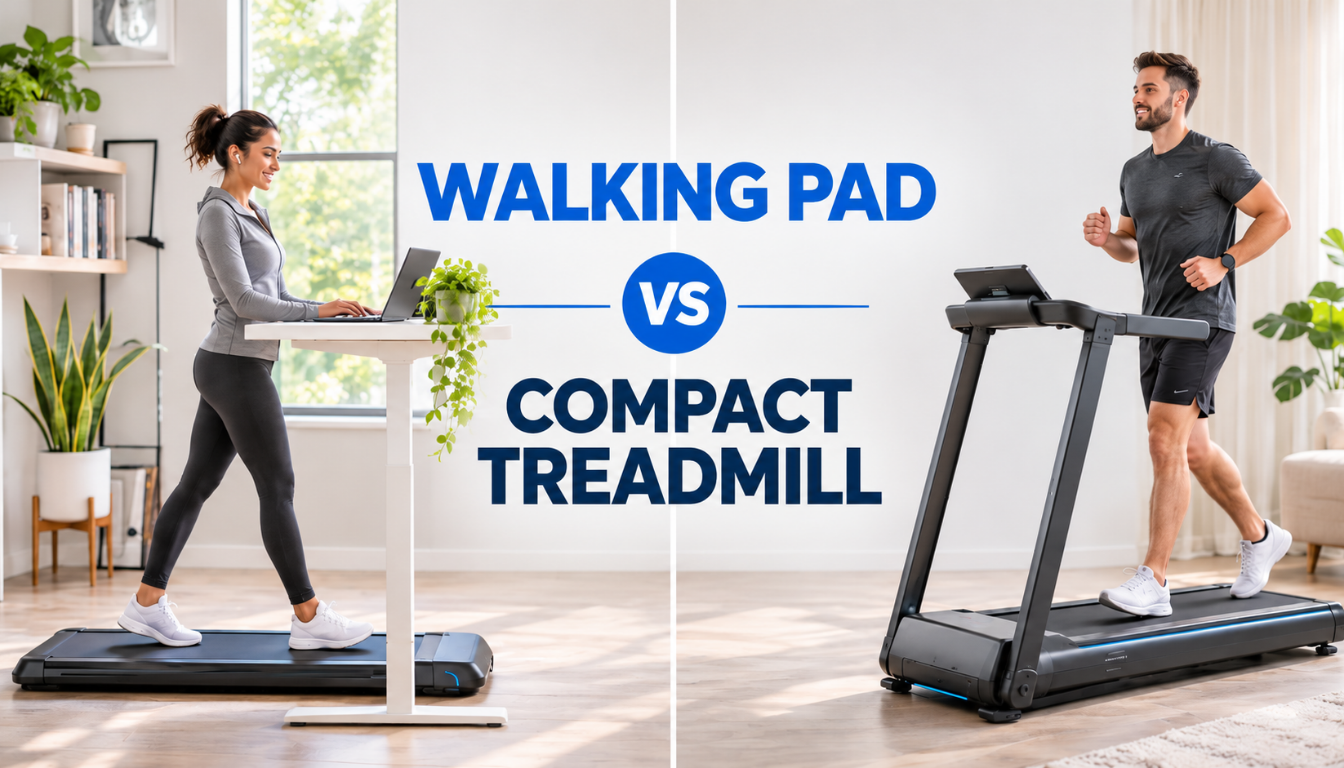
Working from home has made daily routines more convenient, but it has also created a problem many professionals overlook: spending too much time sitting. Between virtual meetings, emails, deadlines, and long hours at a desk, finding time for regular physical activity can become challenging. That’s why compact home fitness equipment is gaining attention, particularly walking pads and foldable treadmills. Both offer the convenience of indoor exercise without requiring a dedicated gym room. However, they aren’t designed for exactly the same purpose. A walking pad is generally built for comfortable walking and compact storage, while a compact treadmill offers greater flexibility for walking, jogging, and sometimes running.
So, when comparing walking pad vs treadmill, which option is better for someone working from home? The answer depends on whether you want to move during working hours, complete structured cardio sessions, or combine both. In this guide, we’ll compare their differences, examine popular models available in India, and help you decide which machine suits your work schedule, apartment size, and fitness goals.
Walking Pad vs Compact Treadmill: What’s the Difference?
At first glance, walking pads and compact treadmills may appear quite similar. Both use a motorised running belt and allow users to exercise indoors. The main differences become clearer when you consider speed, size, support, and intended use.
What Is a Walking Pad?
A walking pad is a slim, compact walking machine designed primarily for low-speed movement. Many models feature a flat deck without a permanent upright console or full-length handrails. Some include remote controls, small digital displays, and wheels for convenient storage. Because of their relatively low profile, selected models can fit beneath a standing desk, allowing users to walk while completing certain work tasks. Walking pads typically offer maximum speeds of approximately 6 km/h, although some hybrid models support higher speeds. They’re especially appealing to people who want to increase daily activity without scheduling separate workout sessions.
What Is a Compact Treadmill?
A compact treadmill is a smaller version of a traditional motorised treadmill. It generally includes upright supports, handlebars, a console, and a broader range of workout speeds. Depending on the model, compact treadmills may also provide incline adjustments, preset programs, cushioning, and connectivity features. A foldable treadmill can be useful for people who want a more complete workout machine but have limited space at home. The major advantage is versatility. You can use the same machine for comfortable walking, brisk walking, jogging, and potentially running.
Walking Pad vs Treadmill: Quick Comparison
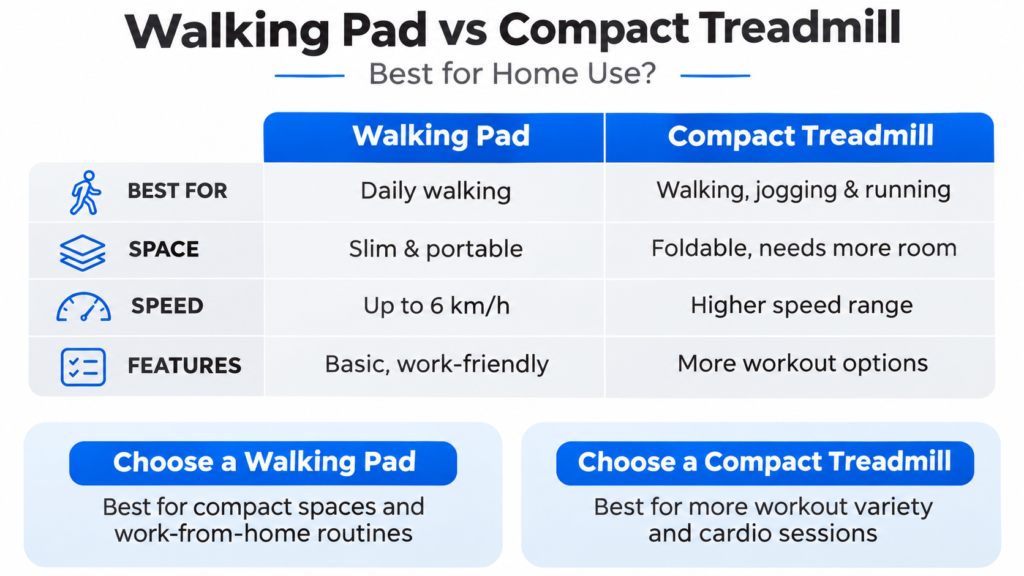
| Feature | Walking Pad | Compact Treadmill |
| Main purpose | Daily walking | Walking, jogging and running |
| Typical maximum speed | Around 6 km/h; varies by model | Often 10-16 km/h; varies by model |
| Under-desk use | Possible on suitable models | Usually unsuitable |
| Handrails | Often absent or foldable | Usually included |
| Storage | Generally slim and portable | Foldable but often bulkier |
| Incline | Limited or unavailable | Manual or automatic on selected models |
| Workout programs | Basic or limited | Often more options |
| Running comfort | Not generally designed for full running | Better suited when appropriately sized |
| Best for | Staying active during desk-based days | Dedicated home cardio workouts |
Both options can support regular exercise. The real question is how you intend to use the machine.
Why Walking Pads Are Popular Among Work-from-Home Professionals
Walking pads are particularly relevant to people who spend most of their working day in front of a laptop. Instead of remaining seated for several consecutive hours, users can introduce short periods of movement into their routine.
Walking While Working
An under desk treadmill can be useful for low-concentration activities such as listening to presentations or attending meetings where active participation is limited. At a suitably slow pace, walking may also be manageable during some administrative tasks. However, walking while typing isn’t necessarily comfortable for everyone. Research on treadmill workstations has found that walking can affect typing and mouse performance, even when certain cognitive tasks remain manageable. For this reason, walking pads are better considered a way to introduce movement into appropriate parts of the day rather than equipment for walking throughout every working hour.
Convenient for Small Apartments
Many Indian professionals work from bedrooms, living rooms, or compact home offices. A traditional treadmill may occupy too much space in these environments. A walking pad for home use generally requires less storage space, and selected slim models can be moved under furniture when not in use. However, always check the product’s actual height and dimensions before assuming it will fit beneath a sofa or bed.
Easier to Build a Walking Habit
One of the biggest benefits of walking pads is convenience. You don’t necessarily need a complete change of clothes or a dedicated exercise session to take a short walk. A comfortable 10-15-minute walk between meetings can help break up long periods of sitting. Over time, these sessions can contribute to your total daily physical activity.
When Is a Compact Treadmill the Better Choice?
Walking pads are practical for daily movement, but they have limitations. A compact treadmill may be more suitable if your fitness goals extend beyond walking while working.
More Flexibility for Workouts
Many compact treadmills offer higher speed ranges than dedicated walking pads. This allows users to progress from walking to jogging and, on suitable models, running. For someone planning structured cardio sessions before or after work, that additional flexibility can be valuable.
Better Support During Exercise
Most compact treadmills feature handlebars and upright frames. These provide convenient points of support when starting or stopping, although users should follow the manufacturer’s instructions and avoid relying on the rails during normal walking.
The additional structure may also make a treadmill more comfortable for users who prefer a conventional exercise-machine design.
Incline Training Options
Incline is another important difference. Selected compact treadmills offer manual or automatic incline systems, allowing users to increase workout difficulty without significantly increasing speed. For example, incline walking can raise cardiovascular demand compared with level walking at a similar pace. However, not every compact treadmill includes an incline function.
A Better Option for Shared Family Use
If multiple family members plan to use the equipment for different workouts, a compact treadmill may be more versatile. One person may prefer walking, while another wants jogging sessions. A suitable home treadmill can accommodate both, provided everyone remains within its specified weight and workout limits.
Best Walking Pads and Compact Treadmills for Home Use in India
To make the comparison more practical, let’s look at selected models from PowerMax Fitness, Cockatoo, and Lifelong. These models offer different combinations of portability, speed, motor technology, and workout flexibility. The comparisons below use published specifications rather than independent hands-on or noise testing.
1. PowerMax WALKPAD-2 – Best for Dedicated Home Walking
The PowerMax WALKPAD-2 Walking Treadmill is designed for users who primarily want regular indoor walking. Its published specifications include a 3.0HP DC motor, speeds up to 6 km/h, and a 900 × 380 mm walking surface.
The machine supports a listed maximum user weight of 110 kg. It also provides LED workout tracking and remote-control functionality, making it convenient for everyday walking sessions.
Key specifications:
- Motor: 3.0HP DC
- Speed: 1-6 km/h
- Walking surface: 900 × 380 mm
- Maximum user weight: 110 kg
- Display: LED workout information
- Control: Remote functionality
What stands out: A walking-focused design with straightforward controls and a compact walking surface.
What to consider: Its 6 km/h maximum speed makes it unsuitable for users who want regular running workouts.
Best for: Work-from-home professionals who prioritise comfortable walking and a compact home fitness setup.
2. Cockatoo SmartWalk 1A – Best for Basic Under-Desk Walking
The Cockatoo SmartWalk 1A is another option for users interested in a slim walking machine. Its published speed range is 1-6 km/h, while the listed maximum user weight is 100 kg. The model focuses on everyday walking rather than intensive running workouts. For buyers comparing walking pads for office and home use, the SmartWalk 1A represents a straightforward alternative.
Key specifications:
- Speed: 1-6 km/h
- Maximum user weight: 100 kg
- Type: Compact walking pad
- Intended activity: Regular indoor walking
What stands out: Walking-focused functionality and a space-conscious design.
What to consider: It isn’t intended to replace a treadmill for regular running. Confirm under-desk clearance and current model dimensions before ordering.
Best for: Beginners who want a simple machine for low-speed walking.
3. Lifelong Fit Pro LLTM162 – Best for Walking With Extra Speed Flexibility
The Lifelong Fit Pro LLTM162 is positioned as an under-desk treadmill for home use. The manufacturer advertises a 2HP motor and a maximum speed of 8 km/h. This provides more speed flexibility than typical walking pads limited to 6 km/h. However, a higher maximum speed doesn’t automatically make it suitable for regular running. Running suitability also depends on the deck dimensions, construction, user capacity, and manufacturer guidelines.
Key specifications:
- Motor: Advertised 2HP
- Maximum speed: 8 km/h
- Type: Under-desk walking treadmill
- Main use: Walking and faster-paced movement
What stands out: A higher speed ceiling than basic walking pads.
What to consider: Check the exact walking surface, approved user capacity, and workout-duration recommendations.
Best for: Users who want a compact walking-focused machine with additional speed flexibility.
4. PowerMax TDM-95 – Best Space-Saving Alternative for Walking and Jogging
For users who want more workout versatility, the PowerMax TDM-95 Motorised Treadmill is worth considering. It features a 4HP brushless DC motor and a speed range of 1-10 km/h. The treadmill has a 950 × 385 mm running surface and supports users weighing up to 110 kg. Its published folded dimensions are approximately 1200 × 545 × 100 mm, giving it a slim storage profile. Additional features include 12 workout programs and transportation wheels.
Key specifications:
- Motor: 4HP brushless DC
- Speed: 1-10 km/h
- Running surface: 950 × 385 mm
- Maximum user weight: 110 kg
- Folded dimensions: 1200 × 545 × 100 mm
- Programs: 12 presets
What stands out: Its combination of compact storage, brushless motor technology, and a higher speed range.
What to consider: The shorter running surface may not suit taller users who want to run with a long stride.
Best for: Work-from-home users who want a compact machine for walking and light jogging after working hours.
5. PowerMax TDM-96B – Best for More Complete Cardio Workouts
The PowerMax TDM-96B Motorized Treadmill offers greater workout versatility than a typical walking pad. Its 4HP DC motor supports speeds up to 14 km/h, making it suitable for walking, jogging, and recreational running.
The running surface measures 1100 × 400 mm, providing more length than the smaller TDM-95. The TDM-96B also includes a hydraulic soft-drop folding mechanism, manual incline adjustment, preset workout programs, and Bluetooth connectivity.
Key specifications:
- Motor: 4HP DC
- Maximum speed: 14 km/h
- Running surface: 1100 × 400 mm
- Maximum user weight: 110 kg
- Incline: Four manual levels
- Folding: Hydraulic soft-drop
- Connectivity: Bluetooth fitness apps
What stands out: A practical combination of higher speed, connectivity, and folding convenience.
What to consider: It’s bulkier than a slim walking pad and requires more dedicated space during use.
Best for: Professionals who want a home treadmill for structured morning or evening cardio sessions.
Walking Pad vs Compact Treadmill: Model Comparison
| Model | Category | Maximum Speed | Listed Capacity | Best For |
| PowerMax WALKPAD-2 | Walking pad | 6 km/h | 110 kg | Everyday walking |
| Cockatoo SmartWalk 1A | Walking pad | 6 km/h | 100 kg | Basic indoor walking |
| Lifelong Fit Pro LLTM162 | Under-desk treadmill | 8 km/h | Verify | Faster walking |
| PowerMax TDM-95 | Compact treadmill | 10 km/h | 110 kg | Walking and light jogging |
| PowerMax TDM-96B | Foldable treadmill | 14 km/h | 110 kg | Walking, jogging and running |
Specifications are manufacturer-listed. Maximum speed does not establish that a machine is suitable for running, and maximum user weight may differ from the recommended running-weight capacity.
Which Is Quieter: A Walking Pad or Compact Treadmill?
Noise is a major consideration for people working from home, especially in apartment buildings. Walking pads are often marketed as quieter than traditional treadmills. However, that doesn’t mean every walking pad produces less noise than every compact treadmill. Actual noise depends on motor construction, walking speed, deck design, belt condition, user weight, and floor vibration. A slow walk generally creates less impact noise than running. This can make a walking pad practical for certain workday activities, but sound transmission through the floor remains a consideration. A suitable treadmill mat may help reduce vibrations and protect flooring. Neither product category is automatically silent, so buyers should look for credible noise measurements rather than relying only on advertising claims.
Verdict: Walking pads can be a practical choice for quieter, low-speed movement, but a brand-level noise winner cannot be established without comparable testing.
Can You Really Work While Walking on a Treadmill?
Walking during work can be useful, but it’s important to set realistic expectations.
Low-speed walking may fit certain activities, such as listening to presentations or attending meetings where you’re not required to type continuously. Tasks that require precise mouse control, sustained typing, or intense concentration may become harder while walking. A walking pad should therefore complement your working routine rather than interfere with productivity.
Tips for Walking While Working
- Start with a comfortable, very slow pace.
- Use a stable, height-adjustable desk with enough legroom.
- Wear supportive footwear.
- Keep cables, furniture, and loose objects away from the moving belt.
- Stop walking before making adjustments that require bending or reaching.
- Avoid walking during tasks that require delicate hand coordination.
If you plan to use a treadmill beneath a desk, choose a model explicitly designed for that arrangement.
Never attempt to place a standard upright treadmill beneath unsuitable furniture.
Which Option Is Better for Weight Loss?
Both walking pads and compact treadmills can contribute to weight management. Walking regularly increases physical activity and energy expenditure, while jogging or running can produce a higher calorie expenditure per minute depending on speed and body weight. However, exercise intensity isn’t the only factor that matters. A walking pad used consistently may be more valuable than a treadmill used occasionally. For instance, a person who walks for several short sessions during their workday may accumulate substantial weekly physical activity. Someone who prefers dedicated jogging sessions may find a compact treadmill more suitable. Neither category guarantees weight loss. Nutrition, total activity, workout intensity, and long-term consistency all influence results.
Verdict: Choose a walking pad if it helps you move more throughout the day. Choose a compact treadmill if you want the flexibility to perform more demanding cardio workouts.
What Should Work-from-Home Users Check Before Buying?
Before purchasing either machine, consider the following factors.
1. Available Space
Measure your room carefully, including the area needed for safe movement around the machine. If you’re considering a walking pad for office use, measure your desk clearance as well.
2. Storage Requirements
Check the product’s actual folded dimensions. Some walking pads slide beneath furniture, while others require vertical storage. Compact treadmills may fold differently and can be heavier to move.
3. Walking Surface
A longer and wider deck can provide more room for a comfortable stride. This becomes particularly important for taller users or those who intend to jog.
4. Motor and Speed Range
Choose a speed range that matches your actual goals. A walking pad with a 6 km/h limit may be adequate for everyday walking, while a faster treadmill provides more flexibility. Compare continuous and peak motor ratings carefully.
5. Weight Capacity
Check the maximum user weight and any separate running-weight restrictions. Consider a reasonable margin above the heaviest intended user’s body weight.
6. Safety Features
Review the manufacturer’s guidance on emergency stopping, remote operation, handrails, belt maintenance, and safe clearances. If children or pets are present, keep the machine secured when not in use.
7. Warranty and Service Support
Check motor coverage, parts and labour warranty, technician availability, and installation requirements. After-sales support can be particularly important when purchasing motorised exercise equipment.
Final Verdict: Walking Pad or Compact Treadmill for WFH?
For most people who primarily want to reduce prolonged sitting and introduce gentle movement during their workday, a walking pad is the more practical option. Its slim design, walking-focused speed range, and compact storage make it suitable for small apartments and home-office environments. However, if your goal includes jogging, running, incline workouts, or structured cardio training, a compact treadmill offers greater versatility. Among the models compared, the PowerMax WALKPAD-2 and Cockatoo SmartWalk 1A are worth considering for walking-focused use. The Lifelong Fit Pro LLTM162 offers an alternative with a higher advertised speed ceiling. For a balance between compact storage and jogging capability, the PowerMax TDM-95 is an option to evaluate. If you want more conventional treadmill features, the PowerMax TDM-96B provides a higher speed range and a longer running deck. Ultimately, the better machine isn’t necessarily the most expensive or powerful. It’s the one you’ll use regularly without disrupting your work or home environment.
Frequently Asked Questions
1. Is a walking pad better than a treadmill for working from home?
A walking pad is usually more convenient for desk-based routines because of its slim design and low-speed operation. A compact treadmill is better suited to dedicated workouts involving faster walking, jogging, or running. The right choice depends on your work activities and exercise goals.
2. Can you use a walking pad under a desk?
Yes, selected walking pads are designed for use beneath suitable standing desks. Make sure there’s adequate clearance, proper desk height, and enough space for safe walking. A standard seated desk generally won’t provide the necessary arrangement.
3. Is a walking pad good for weight loss?
A walking pad can support weight loss by helping increase daily physical activity and calorie expenditure. However, sustainable results depend on total energy balance, nutrition, and consistency. Regular walking can be a useful part of a broader fitness routine.
4. Can you run on a walking pad?
Most dedicated walking pads are designed for walking rather than running. Some hybrid models offer higher speeds, but that doesn’t automatically make them suitable for regular running. Check the manufacturer’s intended use, deck dimensions, and speed limitations before attempting faster exercise.
5. Which is better for small apartments: a walking pad or foldable treadmill?
A walking pad is generally more convenient for very small apartments because it often has a slimmer profile. A foldable treadmill may require more storage space but offers additional workout flexibility. Compare actual dimensions rather than assuming all foldable machines occupy the same space.
6. Are walking pads quieter than compact treadmills?
Walking pads may create less impact noise during slow walking, but total machine noise depends on the motor, running belt, floor construction, and user. Without comparable acoustic testing, it’s difficult to identify which particular machine is quieter.
7. Is a compact treadmill suitable for everyday walking?
Yes. A compact treadmill can be used for regular walking as long as it’s operated within the manufacturer’s recommendations. It may be a particularly useful choice for households where some members want to walk while others prefer jogging or running.
8. What is the best walking pad for home use in India?
Models worth comparing include the PowerMax WALKPAD-2, Cockatoo SmartWalk 1A, and other compact under-desk options. The best walking pad for home use depends on walking surface, user weight capacity, speed range, dimensions, warranty, and personal comfort.
9. Should work-from-home users buy a treadmill or just walk outdoors?
Both can support an active lifestyle. Outdoor walking requires little equipment and offers a change of environment, while indoor walking provides more convenience during bad weather or poor air quality. The best approach may combine outdoor walks with an indoor option for busy days.
10. Which is better for daily use: a walking pad or compact treadmill?
A walking pad is often better for frequent, short walking sessions, especially during desk-heavy days. A compact treadmill is generally better for structured workouts and greater speed flexibility. Choose according to your preferred exercise intensity and available space.
Categories
Tags
Recent Posts
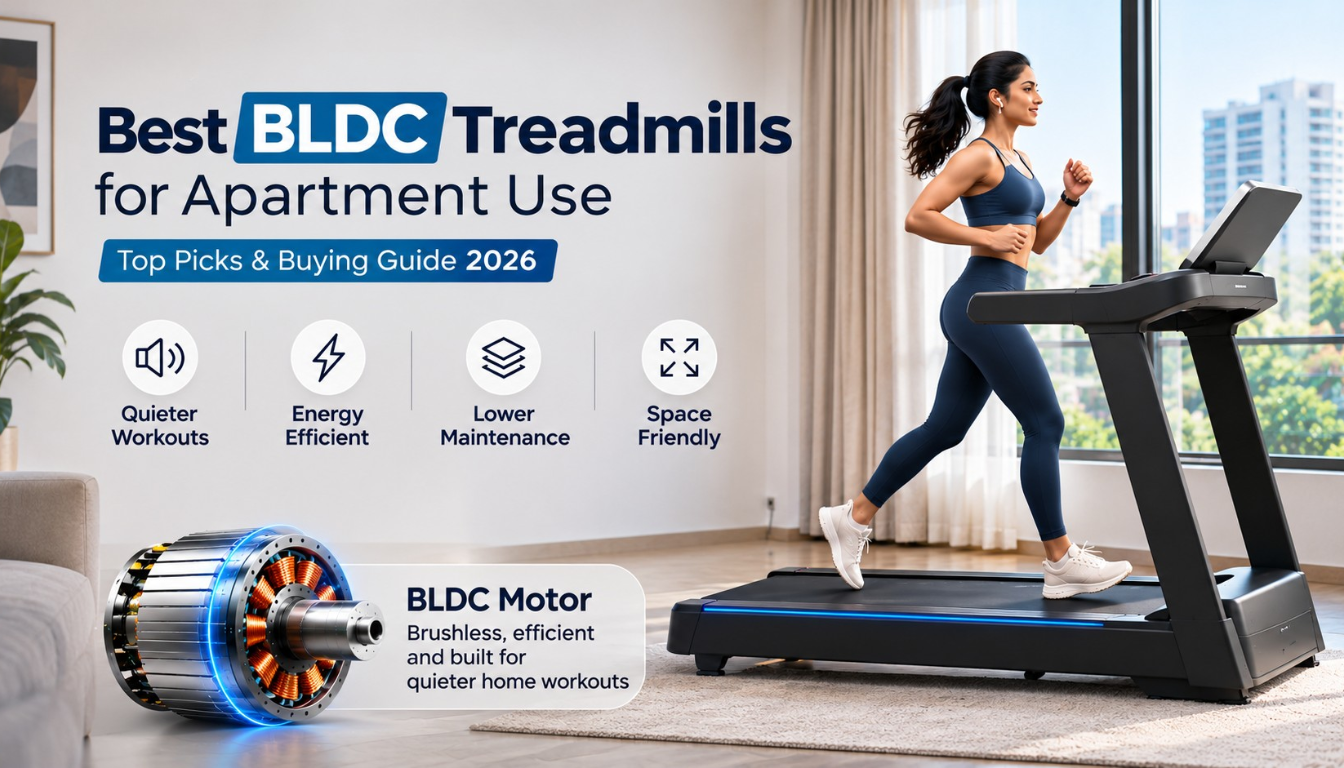
Best BLDC Treadmills for Apartment Use in India 2026
November 3, 2026
The Hidden Cost of Buying a Cheap Treadmill
August 11, 2026
The Most Common Beginner Treadmill Mistakes
July 14, 2026
Treadmill Workouts to Stay in Shape this Summer
March 17, 2025